
Introduction
Soft, wall-to-wall flooring can make a room quieter, warmer, and more comfortable. It can also be confusing to shop for because stores show you pretty samples, but they do not always explain what those samples mean for real life (kids, pets, muddy shoes, and spills). This guide is written to fix that.
If you are considering carpet, you will learn how to pick the right fiber, the right thickness, and the right pad without getting tricked by big warranty numbers or fancy marketing words. You will also learn how to reduce “new flooring smell,” how to avoid moisture problems, and how to clean it in a way that keeps it looking good for years.
I reviewed three major competitor brands’ sites (Mohawk Group, Stark (UK), and Milliken). They do a great job showing styles, design stories, and sustainability claims, but most of their content is aimed at designers or luxury buyers not a busy homeowner who needs clear steps, simple checklists, and plain language. This article focuses on what you actually need to decide and do.
Decide if soft flooring fits your home and lifestyle
Before you shop, decide if this floor type matches your needs. Here are the real pros and cons, in plain words.
Why many homeowners like it
- Comfort: softer under feet, especially in bedrooms and living rooms.
- Noise control: it can reduce echo and help rooms feel calmer. Some brands also promote acoustic benefits in their products and backings.
- Warmth: it does not feel cold like tile in winter.
Common reasons people regret it
- Stains and spills: some fibers handle stains well, others hold onto them.
- Moisture risk: if it stays damp, it can hold smells and support growth you do not want. The EPA warns that damp textile flooring (and many other materials) can become a problem if moisture is not controlled.
- Extra cleaning: you must vacuum and handle spots the right way.
A good “room test”:
- Bedrooms and cozy family spaces often work well.
- Entryways, laundry areas, and damp basements are higher risk unless you choose the right product and manage moisture carefully.
Fibers explained in plain words (wool and common synthetics)
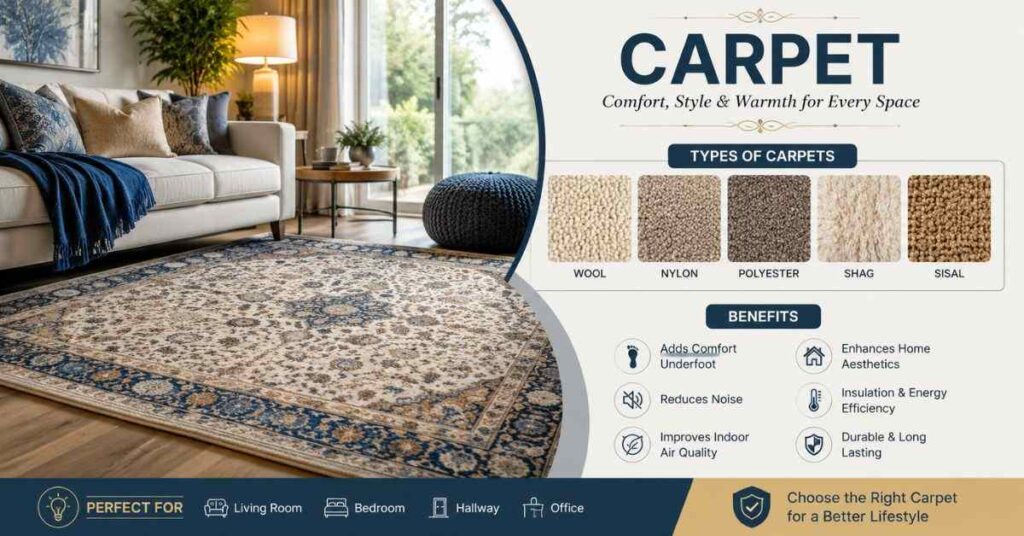
When you shop for carpet, the fiber choice matters more than the color. It affects stain resistance, how it feels, and how it wears over time.
Wool (natural)
- Soft and classic.
- Often chosen for comfort and a premium look.
- Can be more sensitive to water and may need careful cleaning. (Luxury brands often give special care steps, like blotting and rinsing for wool blends.
Nylon (synthetic)
- Known for strength and “bounce-back” in high-traffic areas.
- Often costs more than basic polyester. Forbes Home reported nylon materials commonly in the mid-to-higher price range compared with some other synthetics.
Polyester / PET (synthetic)
- Often a budget-friendly choice.
- Many options are good at resisting stains, but some can “mat down” faster in busy hallways. (Price and performance vary a lot by product line.)
Triexta (synthetic)
- Often marketed for stain resistance and softness.
- It is newer than nylon, so long-term performance can vary by brand and construction. Forbes Home notes it is newer and suggests reviewing samples and benefits with a contractor.
Quick tip: Ask for the fiber type in writing on the spec sheet. If the seller cannot tell you, that is a red flag.
Pile, density, and texture: what the sample is really telling you
Once you understand fiber, the next “make or break” factors are pile style and density (how tightly packed the surface fibers are).
Pile style basics (simple version)
- Cut pile: fibers stand up and are cut at the top. Often feels soft.
- Loop pile: fibers form small loops. Often wears well, but can snag for some pets.
- Cut-and-loop: a mix that can hide footprints and add pattern.
What to look for on a sample
- Twist and resilience: gently rub the sample. Does it spring back, or stay flat?
- Density: bend the sample. If you quickly see the backing through the face fibers, it may wear faster in busy areas.
- Texture vs. cleanup: super shaggy styles can feel cozy, but crumbs and pet hair can be harder to remove.
A simple “real home” rule
- Busy hallway or family room: choose a tighter, more resilient surface.
- Guest room: you can go softer and plusher.
Also, do not be fooled by warranty language alone. Some warranties are marketing tools, not a promise of how it will look after years of kids, pets, and parties.
The pad: comfort, warmth, and fewer dents
A good pad is not a boring add-on it is part of the system. The right one can make the floor feel softer, reduce noise, and help it keep its shape.
Basic pad terms:
- Thickness is how tall it is.
- Density is how firm it is.
Many people assume “thicker is better,” but too much softness can cause problems like ripples or faster wear. CRI guidance for residential cushion often recommends limits like no thicker than 7/16 inch for many cut-pile styles, and thinner/firm options for some loop styles.
A simple way to choose:
- For most living spaces, pick a firm pad, not the squishiest one.
- For stairs, ask your installer what works best for safety and tight fitting.
If you want the best everyday feel, think of the pad as the “supportive shoe” under your carpet—not a pillow. Support usually wins.
Indoor air and low-emission shopping (simple steps for 2026)
Some people worry about “new flooring smell.” The EPA says scientists have not proven a clear link between new textile flooring chemicals and symptoms, but it still suggests steps to reduce exposure when installing new materials.
Simple steps that help
- Ask the retailer to unroll and air out the material in a ventilated area before installation.
- Use low-emitting adhesives if glue is needed.
- Consider being out of the home during install and shortly after.
- Open windows and increase fresh air during and after installation.
What to look for in labels
- “Low VOC” claims are common, but better labels are third-party programs. One widely referenced program is Green Label Plus, described by CRI as identifying among the lowest-emitting products (including adhesives and cushion).
Keep it simple: pick low-emission materials, ventilate well, and avoid trapping moisture.
Moisture, basements, and entryways: prevent musty surprises
Moisture is the biggest hidden risk with soft flooring. The EPA notes that IAQ problems can happen with many materials if there is water intrusion (like leaks), and that damp floor coverings can become a major source of microbial growth.
Where moisture problems start
- Basement concrete that is still releasing water vapor
- Small plumbing leaks under sinks or near water heaters
- Wet shoes and umbrellas near entry doors
- A humid climate with poor ventilation
Practical protection steps
- Use strong entry mats and remove shoes at the door.
- Fix leaks fast (even slow drips).
- In basements, ask your installer about moisture testing and what product systems fit your slab.
Some commercial tile-backed systems are designed to handle moisture better by allowing vapor to move and escape at seams (instead of trapping it). The main lesson for homeowners is simple: do not cover a damp floor and hope it dries later.
If you suspect dampness, solve that first. It is cheaper than replacing flooring later.
Measuring and budgeting: get a realistic number before you buy
Budget surprises usually happen because homeowners measure wrong or forget “hidden” costs (moving furniture, removing old flooring, stairs, and odd room shapes).
Step-by-step measuring
- Measure room length × width in feet.
- Multiply to get square feet.
- Add extra for waste and cuts (installers often add more for closets, angles, and seams).
Budget basics (realistic, not scary) Costs depend on fiber, style, pad, and labor. Forbes Home (audited Feb 26, 2024) reported that materials can range widely per square foot and that professional installation is often an added per‑square‑foot cost; it also notes underlayment/padding adds cost.
Several 2026 pricing guides also describe installed pricing as a wide range that depends on quality and prep work, so local quotes matter.
When you plan your total, include:
- Removal and disposal of old flooring
- Subfloor repairs
- New pad
- Moving furniture (if not included)
8) Installation basics: seams, stairs, and mistakes to avoid
Even high-quality materials can look bad with poor installation. The EPA recommends making sure installers follow industry installation guidelines.
Common installation methods (simple)
- Stretch-in: held by tack strips around the room edges.
- Glue-down: used in some situations, but adhesives should be chosen carefully for emissions.
- Modular squares: easier to replace one damaged piece in some rooms; commercial sources note less cutting waste in some installs (estimates as low as ~1–5% in certain projects), but product choice still matters.
Mistakes to avoid
- Putting seams in the most visible walkway
- Skipping subfloor prep (bumps show up later)
- Installing over moisture problems
- Choosing a pad that is too soft for the style
If you are paying for professional carpet installation, ask for these two things in writing:
- What pad type/thickness they will use
- What the subfloor prep includes
That one step prevents many headaches.
Visual cheat sheets (two tables you can screenshot)
Use these as quick guides while shopping.
Table 1: Quick picks by room and lifestyle (plain language)
| Room / Situation | A safer “default” choice | What to avoid |
|---|---|---|
| Busy family room | Resilient fiber + tighter surface | Very fluffy, loose texture that mats down fast |
| Bedrooms | Softer feel is fine | Extremely light colors if you worry about stains |
| Stairs | Firm pad + durable surface | Overly thick, squishy pad |
| Basement | Only if moisture is controlled | Any install over a damp slab |
| Pets | Stain-resistant fiber + easy-clean texture | Long shag styles that hold hair |
Table 2: Shopping checklist + red flags
| Ask this question | Good sign | Red flag |
|---|---|---|
| What is the fiber and face weight? | Clear spec sheet | “Not sure, but it’s premium” |
| What pad do you recommend for this style? | Firm pad matched to product | “Thicker is always better” |
| What low-emission options do you carry? | Third-party labels and clear answers | No labels, vague claims |
| What prep is included in install? | Written scope of work | “We’ll see on install day” |
| What is the cleaning plan? | Clear routine and warranty-safe methods | “Just rent a machine anytime” |
10) Care routines that work + quick FAQs
The best cleaning plan is simple and consistent. CRI’s care guidance focuses on routine vacuuming, fast spot cleanup, periodic deep cleaning (often every 12–18 months), and stopping dirt at the door with mats and shoe habits.
Luxury care guidance also repeats the same core idea for spills: act fast, blot, don’t rub, and consider periodic professional cleaning.
A simple weekly routine
- Vacuum high-traffic paths several times a week.
- Clean spots the same day.
- Use entry mats and remove shoes.
- Change HVAC filters on schedule to reduce airborne dust settling into soft floors.
Big warning: Do not over-wet the surface. Too much water can cause odor and moisture trouble, especially on concrete or in humid climates.
Frequently Asked Questions
Q1: What is the difference between a modern house and a contemporary home?
A modern house refers to a specific architectural style rooted in the mid-20th century, defined by flat roofs, open spaces, and clean lines. A contemporary home simply means a home that reflects current design trends, which, in 2026, will be warmer and more nature-inspired.
Q2: How much does it cost to renovate a home in 2026?
According to the Joint Center for Housing Studies at Harvard University, U.S. total homeowner remodeling spending is expected to reach a new record high of $524 billion in early 2026. Individual project costs vary widely from a few hundred dollars for cosmetic updates to $50,000+ for full room renovations.
Q3: What is the most important room to renovate for home value?
The kitchen consistently delivers the highest return on investment, followed closely by the primary bathroom. Both rooms are used daily, and even modest upgrades significantly improve how a home looks and feels to both occupants and potential buyers.
Q4: Is biophilic design expensive to implement?
Not at all. You can start small; a few potted plants, a jute rug, linen curtains, and a wooden coffee table all add biophilic warmth without a big budget. More involved features like vertical gardens or skylights cost more but can be added gradually.
Q5: Are there government programs to help pay for energy-efficient home upgrades?
Yes. Federal tax credits are available for qualifying heat pump installations in 2026. Many utility companies offer rebates for Energy Star appliance purchases, and state-level weatherization programs sometimes cover insulation upgrades for eligible homeowners.
Conclusion
In 2026, a great home isn’t the biggest or the most expensive. It is the one designed with real thought, built with quality materials, and shaped around how you and your family actually live every single day.
Whether you are drawn to the warmth of natural wood, the calm of a biophilic garden wall, the efficiency of a solar-powered smart system, or the practicality of a flex room that grows with your family, the best direction is always the one that fits your lifestyle and your values. Home design trends for 2026 point clearly toward intentional living: refined architectural styles, flexible and efficient floor plans, thoughtfully sized homes, and versatile accessory structures. These principles will continue to be relevant long after this year’s trends have passed.
If necessary, begin with a small step. Pick one room, one upgrade, or one system to improve and build from there. The goal is not to build a perfect showroom. The goal is to build a home that feels deeply, genuinely yours. intention, soft flooring is not just a floor it is a foundation for a warmer, healthier, and more beautiful home.