Introduction
Every blogger knows the feeling. You sit down to write, stare at a blank screen, and your mind goes completely blank. It doesn’t matter how long you’ve been writing or how passionate you are about your niche; coming up with fresh, interesting, and useful writing topics is one of the hardest parts of running a blog.
The good news is that writer’s block isn’t a creativity problem. It’s a system problem. With the right strategies, tools, and thinking frameworks in place, you will always have something to say. Great content creators don’t wait for inspiration to strike—they build a repeatable process for generating it.
This guide gives you that process. Whether you are a brand-new blogger looking for your first few blog post ideas or an experienced content creator trying to reinvigorate a blog that’s gone a little stale, everything you need is right here. You’ll learn how to find topics your readers actually care about, how to use tools and trends wisely, how to structure your content for maximum impact, and how to build a sustainable content calendar that keeps your blog active, relevant, and growing in 2026.
Why Finding the Right Writing Topics Still Matters in 2026
It’s important to note from the outset that not all content is created equal. Publishing something just to fill a slot in your content calendar is not the same as publishing something that genuinely helps, educates, or entertains your readers. The goal here is simple: understand why blogging trends in 2026 favor depth over speed, ownership over platforms, and consistency over hype and what that means if you want your content to last.
That mindset is the starting point for everything. In 2026, the internet is more crowded than ever. Millions of articles are published every single day. Over 60% of internet users still read blogs and spend meaningful time with them, but they have also become more selective. They are quicker to click away if content doesn’t immediately offer real value. After years of platform-first content and algorithm chasing, blogs are being evaluated on usefulness, credibility, and staying power. That is a good thing for serious bloggers. It means that choosing the right topic, one that genuinely solves a problem, answers a real question, or tells a meaningful story, matters far more than publishing frequently. One strong post that solves a real problem will outperform several average ones, regardless of posting frequency or current trends.
The takeaway? Before you write anything, make sure you’re choosing a topic with a purpose. A clear audience in mind. A real reason to exist. That’s the standard to hold yourself to in 2026, and the rest of this guide will show you exactly how to meet it.
How to Understand What Your Audience Actually Wants to Read
The biggest mistake new bloggers make is writing topics they find interesting without first checking whether their readers feel the same way. The most successful content is always audience-first.
Finding the right blog post ideas starts with one simple question: What does my reader need right now? That question sounds basic, but most people skip it entirely. They guess. They copy. They follow what seems popular without checking whether it aligns with their own audience’s actual needs and questions.
Here are the most effective ways to understand your audience in 2026.
Read their questions.
Look at the comment sections on your own posts. Browse Reddit threads, Quora answers, and Facebook groups in your niche. The questions people ask publicly are a goldmine of topic inspiration. Every unanswered question is a potential post.
Use Google’s People Also Ask section.
When you type a keyword into Google, scroll down to the “People Also Ask” box. These are real questions real people are searching for. Writing posts that directly answer those questions positions you for featured snippets and strong organic traffic.
Check your own analytics.
High traffic with low time on page means readers aren’t finding what they need. Look at how readers spend time, where they drop off, and whether they return. The posts people stay on longest tell you what they love. The posts they leave quickly tell you where you’ve missed the mark.
Survey your email subscribers.
A simple one-question email “What’s the biggest challenge you’re facing with [your niche] right now?” can generate dozens of topic ideas directly from the people you’re writing for.
Understanding your audience doesn’t have to be complicated. It just has to be intentional.
The 10 Best Content Formats That Actually Work in 2026
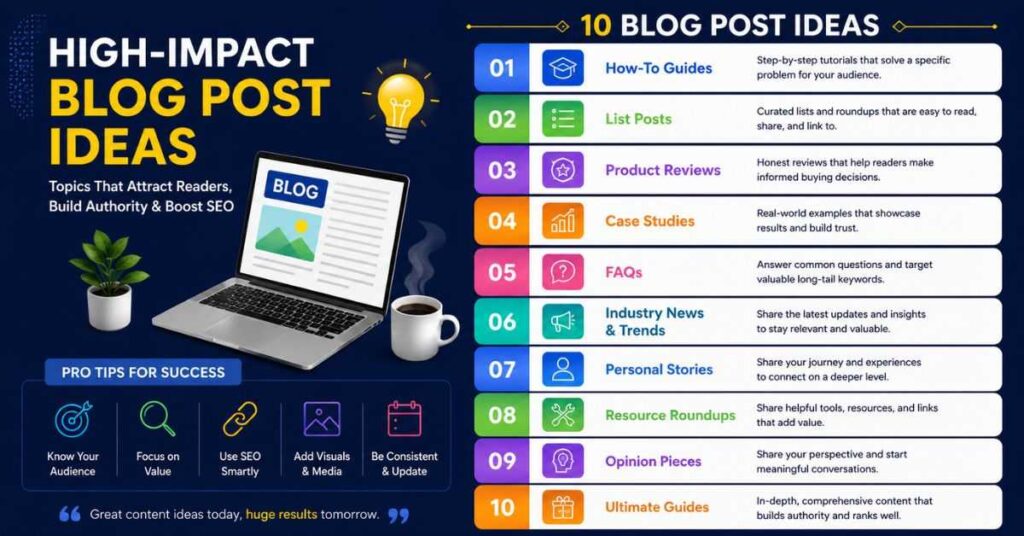
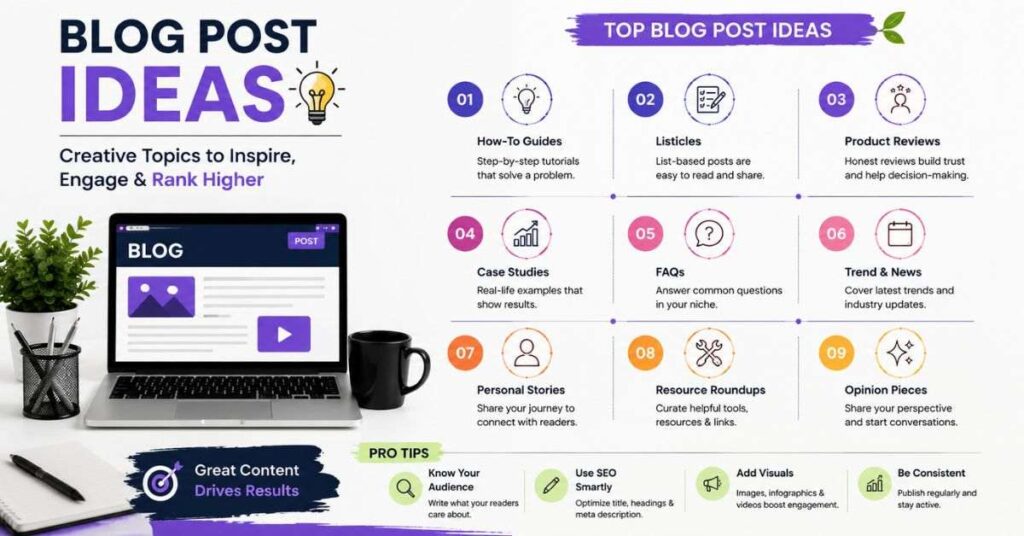
Once you know what your readers want, you need to know how to present it. Content format matters enormously. The same information packaged as a step-by-step how-to guide will outperform the same information published as a loose collection of thoughts.
Here are the content formats that are consistently driving the strongest results for bloggers right now: “Ultimate Guides,” “How-To” articles, and “Big Question” posts perform extremely well because they give both humans and AI the information they need.
How-To Guides
These break a complex process into simple, numbered steps. They’re easy to follow, easy to skim, and incredibly shareable. Every niche has dozens of “how to” questions waiting to be answered.
Listicles
Strong listicles help readers sort options fast. They work best when the audience needs a shortlist, a pattern library, or a practical set of choices before committing to one direction.
Beginner’s Guides
A comprehensive beginner’s guide that breaks down the first steps anyone should take when entering your field is one of the most evergreen pieces of content you can create. It attracts new readers continually over time.
Case Studies
Real examples with real results build trust instantly. Sharing what worked, what didn’t, and what you’d do differently makes you relatable and credible at the same time.
Expert Roundups
Interviewing industry experts in your niche and sharing their insights, tips, and advice is a powerful format that adds credibility, creates shareable content, and often earns you backlinks.
Opinion and Thought Leadership Posts
Sharing your opinion on a controversial or thought-provoking topic in your niche, backing it up with logical arguments, sets you apart from the thousands of blogs that only publish safe, generic information.
Trend Reports
Making predictions about upcoming trends and developments in your niche, backed by research and insights, positions you as an authority who thinks ahead rather than always following behind.
Personal Stories
These are the hardest to copy and the easiest to connect with. Readers return to blogs because they trust the voice behind them. Personal stories build that trust.
Resource Roundups
Compiling an ultimate list of resources, tools, websites, or apps that your audience can refer to for comprehensive information regarding a specific topic gives your readers real, practical value in one convenient place.
FAQ Posts
Dedicated posts that answer the ten most common questions in your niche are searchable, scannable, and extremely useful for capturing long-tail traffic.
Trending Topics by Niche
No matter what your blog is about, certain themes are performing particularly well right now. Understanding what’s resonating across different audiences helps you craft timely, relevant content that connects.
Technology and AI
AI-related topics dominate search results and will remain relevant thanks to global curiosity and widespread adoption. This year, readers want to know one thing: “How do I understand and use AI without feeling overwhelmed?”
If you write about technology, business, or productivity, AI is your richest source of topic inspiration in 2026. Think tutorials, comparisons, ethical debates, and real-world use cases.
Personal Finance and Money
Everyone wants to make smarter decisions with their money, and these topics will provide tons of value. Budgeting strategies, investing basics, passive income ideas, and side hustle guides consistently attract large, engaged audiences.
Health, Wellness, and Longevity
The push toward longevity and high-performance living is real. People are measuring sleep cycles, tracking glucose, meditating, and experimenting with high-protein habits. Content that bridges science and practical daily habits is performing especially well in this space.
Sustainability and Eco-Friendly Living
Sustainability remains a powerful niche. Readers want actionable, realistic advice for living more sustainably, not lectures but practical guidance they can actually implement.
Blogging, Content Creation, and Online Income
There’s a huge audience interested in learning how to build a profitable blog and navigate the world of online income generation. This niche offers the opportunity to share your expertise and guide others on their own blogging journeys.
Home and Lifestyle
DIY projects, home organization, interior décor, and cooking remain reliably popular. When you write about topics that can improve people’s lives, your target audience will be excited to click!
How to Use Google, Social Media, and AI Tools to Find Topics Fast
You don’t have to brainstorm in a vacuum. In 2026, there are more tools available for content research than ever before, and the smartest bloggers use them consistently.
Google Search
Start by typing your core topic into Google. Look at the autocomplete suggestions; these are based on what people are actively searching for. Then scroll to “People Also Ask” and “Related Searches” at the bottom of the results page. These give you immediate, search-validated topics based on real user behavior. Free tools like Google Trends help check if interest in your potential niche is stable or growing. Use it to compare topic ideas side by side and see whether interest is seasonal, growing, or declining.
Keyword Research Tools
Tools like Ahrefs, SEMrush, and Google Keyword Planner help you find long-tail keywords, specific phrases that people type into search engines. Effective keyword research is crucial for your content to reach its intended audience. In 2026, AI-powered tools help surface emerging trends and high-value keywords. Focus on understanding search intent, identifying long-tail opportunities, and leveraging semantic variations.
Social Media
Pinterest trends, Twitter/X hashtags, Instagram Explore pages, and LinkedIn comment sections are all live research tools. When you see something sparking engagement, a debate, a question, or a viral statistic, ask yourself whether there’s a blog post in it.
AI as a Brainstorming Partner
In 2026, the smartest content creators don’t use AI to replace ideas but to expand them, test angles, repurpose assets, and maintain consistency at scale. Give AI one solid topic and it can generate dozens of new angles, hooks, and content formats.
The key is how you use AI. The strongest blogs use AI to remove friction, then rely on human judgment to shape the final message. AI is a brainstorming accelerator, not a replacement for your own voice, perspective, and expertise.
Your Own Readers
Don’t overlook the most direct source: your own audience. Hosting a live Q&A session on social media or creating a post where you answer commonly asked questions from your audience is both a research strategy and a content strategy in one. When readers ask you questions directly, those questions are telling you exactly what to write next.
Evergreen vs. Trending Topics: How to Balance Your Content Calendar
One of the most important strategic decisions every blogger faces is this: should you write about what’s trending right now or focus on topics that will stay useful for years to come?
The honest answer is both but in the right proportions.
Evergreen content is material that stays relevant and keeps attracting readers long after it’s published. Think “how to start a blog,” “beginner’s guide to budgeting,” or “how to take better photos.” Evergreen editorial calendar ideas create lasting assets that continue delivering value long after publication. These posts form the foundation of a blog that generates consistent, compounding traffic over time.
Trending content is timely and built around current events, seasonal moments, or emerging topics. A well-placed trending post can drive a massive short-term traffic spike. It gets shared, discussed, and linked to. But it also fades quickly.
The best content strategy balances both: 70% of your content should be timeless; 30% can be trending. That ratio keeps your blog building long-term authority while staying fresh and current enough to attract new readers.
Combining these two types of blog post ideas into a well-planned content calendar is one of the most practical steps you can take to keep your blog growing steadily all year round. Build your evergreen content first; it’s your foundation. Then layer in timely posts around seasons, events, and emerging conversations in your niche.
Pro Tip
One great way to maximize both is called content repurposing. According to HubSpot’s 2026 State of Marketing Report, 94% of marketers use content repurposing, with 46% reporting positive results for engagement and leads. Marketers who repurpose see 40% higher content output without proportionally more creation time.
A single long-form blog post can become a social media carousel, an email newsletter, a short video, a podcast episode, and an infographic. That is how you make every piece of content work harder.
Writing Headlines and Titles That Get Clicks
You can write the most useful, well-researched, beautifully structured post in the world and nobody will read it if the headline doesn’t make them want to click.
The headline is the single most important element of any piece of content. It determines whether someone clicks or keeps scrolling. In 2026, with AI-generated content flooding the internet, a headline that sounds human, specific, and compelling is more valuable than ever.
Here are the headline formulas that consistently work:
The How-To
“How to [Achieve Desired Result] Without [Common Pain Point]” Example: How to Grow Your Blog Audience Without Spending Money on Ads
The Numbered List
“[Number] Ways to [Achieve Result] in [Timeframe]” Example: 7 Ways to Write Better Blog Posts in Half the Time
The Question
“Why Is [Common Belief] Wrong? Here’s What Actually Works” Example: Why Posting Every Day Isn’t Growing Your Blog — And What to Do Instead
The Beginner’s Promise
“The Complete Beginner’s Guide to [Topic] in [Year]” Example: The Complete Beginner’s Guide to Monetizing Your Blog in 2026
The Mistake Warning
“[Number] [Topic] Mistakes That Are Costing You Readers” Example: 5 Blogging Mistakes That Are Quietly Killing Your Traffic
The Personal Story
“How I [Achieved Result] in [Timeframe] And What I Learned” Example: How I Grew My Food Blog to 50,000 Monthly Readers in 18 Months. People don’t click on posts because of keywords. They click because something made them feel something. They click because the title stirred a question. They stay because the writing answered it with clarity and confidence.
Test your headlines before you publish. Read them out loud. Show them to someone outside your niche. If they make someone curious, you’re on the right track.
Building a Content Calendar That Keeps You Consistent
Consistency is the single biggest predictor of blogging success. It’s not the most exciting insight, but it is the truest one. A blog that publishes reliably even once a week will outperform a blog that publishes brilliantly but unpredictably.
A content calendar is how you stay consistent without burning out.
Decide your publishing frequency.
Consistency is key. For most bloggers, posting once or twice a week is ideal. However, quality always matters more than volume. One optimized, long-form post each week aligns with Google’s helpful content updates for 2026, rewarding expertise and authentic insights.
Choose your content pillars.
Use 3–5 core themes (educate, entertain, inspire, engage, and promote) to organize all your ideas. These pillars keep your content focused and make planning much easier.
Plan one month at a time.
Map out your topics for the next four weeks. Include a mix of evergreen and timely content. Assign each post a format (how-to, listicle, case study, etc.) and a target keyword.
Batch your writing.
Sit down once or twice a week and write multiple posts in one session. Batching is far more efficient than writing one post at a time, because you get into a flow state and stay there.
Leave room for flexibility.
Real life and real news happen. Keep one or two slots in your calendar open for reactive posts—something happening in your niche right now that you can speak to with authority. Businesses that blog regularly generate significantly more leads because each post can drive conversions for months or even years. This is why blogging is a long-term investment that keeps paying off.
Choosing the Right Niche: Finding Your Corner of the Internet
Before any of the topic-generation strategies in this guide can fully work, you need to be clear on one foundational thing.
A niche is a focused area within a broader topic. Instead of blogging about fitness in general, you might focus on yoga for beginners or quick workouts for busy parents. This approach makes it easier to build a loyal readership that really cares about your content.
In 2026, the most successful blogs are niche blogs, not general ones. The internet already has millions of general lifestyle blogs. What it always needs more of is specific expertise, clearly communicated, for a well-defined audience.
Here’s how to choose your niche:
Follow genuine interest, not just profit.
Consider your interests and expertise when selecting a blog topic. The best blogs come from genuine passion for a subject. Writing about something you don’t care about is not sustainable, and readers can always tell.
Validate the market.
Make sure people are actually searching for topics in your potential niche. Use Google Trends to check whether interest is stable or growing. Browse Amazon and Udemy to see whether books and courses are being created in this space a sure sign there is a paying audience.
Go narrow enough to stand out and broad enough to grow.
“Health and fitness” is too broad. “Marathon training for busy parents over 40” is a strong niche specific enough to build real authority and broad enough to generate years of content ideas.
Research the competition without being discouraged by it.
Competing blogs are proof that an audience exists. You don’t need to be the only voice in a niche you need to be the most useful, most relatable, or most distinctive one.
Once your niche is clear, generating new writing topics becomes much easier. Every piece of content you create connects back to who you’re writing for and why, and that clarity shows in every word.
Promoting Your Content So More People Actually Read It
Writing great content is only half the job. In 2026, promoting your blog post requires a strategic blend of channels, tactics, and analytics. With readers consuming content everywhere, a thoughtful distribution plan ensures your efforts achieve maximum visibility and engagement.
Here’s what a smart 2026 promotion strategy looks like
Email newsletters.
Your email list is your most valuable asset as a blogger. Unlike social media followers, email subscribers are people who chose to hear from you directly. Send a short, personal note every time you publish, highlight the key takeaway, and give them a reason to click.
Social media: choose wisely.
Focus on the social networks where your ideal audience spends time: Pinterest for visual niches, Instagram for lifestyle, or LinkedIn for professional topics. You don’t need to be everywhere. Pick two platforms and use them consistently and well.
SEO (Search Engine Optimization).
A consistent blog strategy helps you target long-tail keywords, strengthen your site’s domain authority with quality backlinks, and keep visitors engaged longer through valuable, educational content.
Content repurposing.
Repurposing your blog post into short videos, podcasts, or infographics helps engage diverse audiences. One blog post can fuel an entire week of social media content. Don’t let great writing disappear after one day.
Internal linking.
Every post you publish should link to two or three other related posts on your site. This keeps readers on your blog longer, reduces bounce rates, and signals to Google that your content is well-organized and authoritative.
Community engagement.
Share your posts in relevant Facebook groups, Reddit communities, and niche forums but only when it’s genuinely useful to the conversation. Spam is immediately obvious and damages your reputation. Authentic, helpful contributions build it. Your blog becomes the content engine that powers your entire digital strategy. Treat it that way, not as a standalone activity, but as the hub from which everything else flows.
Visual Reference: Quick Summary Tables
Table 1: Complete Guide to Content Formats: When to Use Each One
| Content Format | Best Used For | Traffic Type | Difficulty Level | Time to Rank |
|---|---|---|---|---|
| How-To Guide | Teaching a skill or process step by step | Organic (search) | Medium | 3–6 months |
| Listicle | Organizing multiple options or ideas | Social + Search | Low–Medium | 1–4 months |
| Ultimate / Pillar Guide | Comprehensive topic coverage | Organic (long-tail) | High | 6–12 months |
| Personal Story | Building trust, humanizing your brand | Social + Email | Low | Immediate |
| Case Study | Demonstrating results and expertise | Organic + Referral | High | 3–6 months |
| Expert Roundup | Borrowing credibility, attracting shares | Social + Referral | Medium | 1–3 months |
| Beginner’s Guide | Attracting new audience segments | Organic (evergreen) | Medium | 3–6 months |
| Trend Report / Predictions | Establishing thought leadership | Social + Email | Medium–High | Immediate |
| FAQ Post | Capturing long-tail question searches | Organic (featured snippets) | Low | 1–3 months |
| Resource List / Roundup | Providing a curated toolkit | Organic + Social | Low | 2–4 months |
| Opinion / Hot Take | Sparking discussion and engagement | Social + Email | Low | Immediate |
| Interview Post | Adding external authority and variety | Social + Referral | Medium | 2–4 months |
Table 2: Evergreen Topic Ideas by Niche Ready-to-Use Writing Prompts for 2026
| Blog Niche | Evergreen Topic Ideas | Trending 2026 Angle |
|---|---|---|
| Personal Finance | “How to Build an Emergency Fund From Zero” | “AI-Powered Budgeting Apps: Do They Actually Work?” |
| Health & Wellness | “10 Daily Habits That Will Change Your Energy Levels” | “Biohacking for Beginners: Longevity Trends in 2026” |
| Technology | “A Beginner’s Guide to Cloud Storage” | “How to Use AI Tools Without Losing Your Creative Voice” |
| Food & Cooking | “5 Weeknight Dinners Anyone Can Make in 30 Minutes” | “What Is the Gut-Brain Diet? A Simple Explanation” |
| Travel | “How to Travel on a Tight Budget Without Sacrificing Comfort” | “Slow Travel in 2026: Why Fewer Destinations = Better Trips” |
| Parenting | “Simple Screen Time Rules That Actually Work for Families” | “Raising Digital-Literate Kids in an AI World” |
| Blogging & Business | “How to Write a Blog Post in 90 Minutes” | “Should You Use AI to Write Your Content? Honest Pros & Cons” |
| Sustainability | “15 Easy Swaps to Reduce Your Plastic Use at Home” | “Carbon Footprint Tracking Apps: Which Ones Are Worth It?” |
| Home & Lifestyle | “How to Organize a Small Home Without Buying More Storage” | “The Soft Life Movement: What It Is and Why It’s Growing” |
| Fitness | “A 20-Minute Workout Routine for People Who Hate Exercise” | “Zone 2 Training Explained: Why Everyone Is Talking About It” |
Table 3: Content Calendar Template One Month of Blog Post Ideas
| Week | Post Type | Topic Example | Target Keyword | Promotion Channel |
|---|---|---|---|---|
| Week 1 | How-To Guide | “How to Grow Your Email List Without Paid Ads” | grow email list free | Email + Pinterest |
| Week 2 | Listicle | “12 Free Tools Every Blogger Should Be Using in 2026” | free blogging tools | Instagram + LinkedIn |
| Week 3 | Case Study | “How I Doubled My Blog Traffic in 3 Months (What I Did Differently)” | increase blog traffic | Social + Email |
| Week 4 | Evergreen / FAQ | “Beginner’s Guide: How to Start a Blog From Scratch” | how to start a blog | SEO + Pinterest |
Frequently Asked Questions
Q1: How do I come up with blog post ideas when I feel completely stuck?
Start with your audience’s real questions browse Reddit threads, Quora, and Google’s “People Also Ask” section for your niche. Also re-read your own most popular posts and think about what related questions they leave unanswered.
Q2: How many posts should I publish each week to grow my blog?
Consistency matters more than volume. One optimized, long-form post each week aligns with Google’s helpful content updates for 2026, rewarding expertise and authentic insights. Quality always beats quantity.
Q3: Is AI going to replace bloggers in 2026?
AI can speed up and enhance the process, but human creativity and authenticity will still matter. The blogs that struggle are the ones using AI to avoid thinking not the ones using it to think more efficiently.
Q4: What is the difference between evergreen and trending content?
Evergreen content stays useful for years,think “how to write a great headline.” Trending content is timely and tied to current events or emerging topics. A smart content strategy makes 70% evergreen and 30% trending, giving you long-term traffic plus short-term visibility.
Q5: How do I know if my blog niche is profitable?
A profitable blog isn’t just about making a few extra bucks it’s about generating sustainable income. The most common ways bloggers make money include affiliate marketing, sponsored posts, digital products, and advertising. Research whether brands are advertising in your niche and whether affiliate programs exist both are strong signals of monetization potential.
Conclusion
Here is the simple truth about blogging in 2026: the bloggers who succeed are not the ones who write the most. They are the ones who understand their audience deeply, choose their topics strategically, and show up consistently with content that genuinely helps people. Blogs are showing up where social posts disappear, holding attention longer, and building authority in ways short-form content can’t. That is a genuinely exciting reality for anyone committed to the long game of building a great blog.
Every tactic in this guide, from audience research to keyword tools, from content repurposing to evergreen planning, is designed to help you stop guessing and start creating with purpose. You now have the frameworks, the formats, the niche strategy, and the promotion playbook to build a content engine that grows month after month.